Tuesday, June 2, 2009

Mr. Coffee Model VBX20: Drippiest Coffee Maker Ever?

Certainly, drip coffee makers are expected to drip in order to perform their life-sustaining function of brewing coffee quickly and reliably. This Mr. Coffee Model, the VBX20- (an inexpensive model, I grant you) delivers, however, a large number of extraordinarily stupid and irritating drip modalities that render it, in the domain of kitchen appliances, something akin to an infant learning to eat cereal. It is a messy affair, from start to finish. The coffee it brews is fine, let's fact facts: that is mostly about coffee plus water, but soiling the counter top is an unacceptable by-product, and is indicative of an intolerable level of carelessness from the industrial designers responsible for creating this insulting plastic monster. Joe DiMaggio would be aghast. Let me explain.


First, if you look at the back of the machine, on the far right in the photo, you will note two holes in the water tank. Bizarrely, should you attempt to fill the tank with water from the carafe and approach at anything but a precisely correct angle, water will spew forth from the holes. Ludicrous. Then, when the dripping process begins, it is accompanied by spattering, as seen in the middle image. Should you interrupt the brewing process before completion, a fairly standard technique of morning coffee lovers, the dripping head will not cease its dripping instantly. One, two, three four, five remaining drips will luxuriantly emerge from the spout and tumble onto the heated platter below, where they spatter and vaporize. Invariably, if you place the carafe on the counter- something I know by now never to attempt, you will be the proud papa (or mama) of a charming series of coffee rings.


The final and most egregious insult comes from the mere act of POURING the coffee into your cup. This, the quintessential act of coffee maker deployment fails, in the typically baffling drippy manner of the VBX20. With every pour, mysterious drops of coffee unavoidably scatter on your counter top. Have your handi-wipe handy, that's all i can offer as advice.
It's more than a coffee maker. It is a mess maker.

Wednesday, May 27, 2009

Iron Chef: Battle Spice Chopper

SANYO DIGITAL CAMERA           Two chopping implements compete to see which one will reign supreme. The contestants are: the Herb Mill, which comes to our competition with the lofty pedigree of Zabar's, and, second, the Mezzaluna Knife, a gift of uncertain origin bearing the name Hoffritz, which sounds sufficiently fancy to command respect, as opposed to say, Ronco. IHT00051Don't get me wrong, Ron Popeil is an illuminati of our era, he's just not featured in this competition, and to me his name conjures up plastic more so than steel.

I tested both gadgets on mint and parsley and, additionally, I tested the Mezzaluna on fresh rosemary. The results were fascinating.

The leafy herbs are quickly reduced to mince with the herb mill but, given the milling nature of the process, there is a high degree of leaf crushing that accompanies the mincing. The process, though, is fast and the herbs are easily removed by simply throwing the handle into reverse, or by pulling them off the bottom, which can be done with little fear of slicing one's finger on the blades. The overall construction of the gadget is a bit flimsy and it feels as if it may suddenly disassemble itself from the violence of its operation. However, over the many years that I have employed it this has never occurred. The end result is a pile of smashed and shredded leaves that are perfect for taboulleh.

The Mezzaluna knife is a completely different beast, and I must say, despite a couple of drawbacks, it could become my go-to gadget for chopping herbs. Unlike the herb mill, which can deposit its efforts directly into a bowl, the knife requires the use of a cutting board. Although this means you will have another surface to clean, it also affords much more control over the mincing process, allowing you to mince leaves in a continuous spectrum of sizes from large coarse flakes to tiny little crumbs. This was particularly useful with the rosemary, which I seldom, if ever, chop in the herb mill. Rosemary was easily reduced to dust with the Mezzaluna, a consistency that renders it ideal for sauces, where large needles would be objectionable.

The most serious drawback to the Mezzaluna is that bulk amounts of unchopped leaves cower between its double blades, and must be continually forced back onto the chopping surface. This can be performed by inserting one's finger from the top of the knife blades, nevertheless, it represents a somewhat more dangerous exposure of the digits to the blades and would necessitate some sober care, particularly if one likes to sample the wine that will be served with dinner, as I am known to do.

Saturday, April 11, 2009

Peasant Food Gone Wild: A Recipe

Several years ago, when Daniel Boulud opened another of his grand palaces of degustation, I noted that the menu included, nay, featured, certain items that should only be characterized as offal, and also, though perhaps not fitting precisely within this characterization, pieds de cochons, which I am pretty sure is French for 'proceed with caution.' I took it all as the antics of another bored chef-genius, who, tiring of short ribs and steak-frites, felt the need to delve deeper within his animal. A press release quoted him saying he had been 'transported back to the food of his childhood.'  A recent glance at the Bar Boulud menu turned up this telltale positioning of charcuterie as merely 'cute':

FROMAGE DE TÊTE GILLES VEROT 
HEAD CHEESE TERRINE
GILLES VEROT'S AWARD WINNING SPECIALTYtete

My main purpose here, though, is not to dwell on innards and the pursuit of grossification, but to point out that in cooking, the dream of the Alchemist sees its true realization. From baser ingredients come precious masterpieces. There is a certain process whereby the humble onion, the potato, a pasta, bean, a simple thing, achieves a unity with its fellow pot-sharing comestibles that is not fully explicable in terms of the backward-engineered recipe, as achievable as this may be.  E pluribus unum, as the dollar bill would have it: out of many, one. Call it a gestalt of cooking. The 'season, taste, repeat' cycle of fine-tuning flavors is aimed at hitting a bulls-eye that is a unitary experience, not a mere mixture of ingredients.  I submit for your approval: the mac 'n cheese, the chili, the pasta e fagioli. A catalog of comfort foods, perhaps, but ones built upon a few simple ingredients that magically harmonize in one another's presence like the understudy cast of a Broadway play who, together, trump a playbill of stars.

And so I turn to another such recipe, one that I've only recently encountered, but which perfectly fits into this category: Bacalhau à Brás.  This is a Portuguese recipe which I can describe, without oversimplifying, as a salt-cod hash. I first sampled it in Maplewood NJ at Churrasco BBQ & Steakhouse. The video clip shown above is a bit more high-brow in execution, with its fancy prawns and cucumber,  but is still in the same vein.

churrasco

how to talkcod Let me rewind a bit to touch on my fascination with salt-cod.  It's a big topic and an entire foodie book has been written about it.  I really haven't read that book,  so I'll just summarize according to another book I haven't read. If you remember anything about 'Mutiny on the Bounty,' you'll recall Captain Bligh, whose name sometimes connotes cruelty, but should instead summon the qualities of intellect, loyalty and steadfast courage. He was a brilliant sailor, managing to navigate 3000 miles of the Pacific, in a dingy,  to save the lives of the fraction of the crew who fulfilled their sworn allegiance to the captain of their vessel. Well, it turns out that Bligh's mission, foiled in the famous case, but later revisited, was to transplant breadfruit trees from the Pacific Islands to the Islands of the Caribbean in order to feed a growing population of slaves, cut-off by the Revolutionary war from their life-sustaining supply of salt-cod. As it so happened, the enslaved workers balked at the breadfruit, in all of its various preparations: steamed, as a pudding, tofurkey style- none of it was for them. Even today, throughout the Caribbean, you will find the lingering evidence in a continued reverence for salt-cod dishes. And let's not forget who was doing all that fishing. It was the Portuguese emigrant, who had settled in Newfoundland or Fall River, or New Bedford. They sailed out on large creaky vessels and then were dropped over the side in tippy little dories with nothing more than oars, hooks, bait, and a few hundred feet of fishing line. But they caught lots of fish! Of course, in the absence of refrigeration, the proven method of preserving their catch was desiccation through salting.  In a culinary sense, this is where  my interest was piqued.

One revives the salted fish through immersion in a fresh-water bath, changing the water over the course of a couple of days, by which time most of the salt will have been removed. Today this happens in the fridge of course, but I suppose it would have been done at room temperature in bygone days. Bye, gone days! Now the fish is ready for cooking. Whichever recipe you choose, one fact that becomes apparent immediately is that you have not, through the water bath process, returned the filets to their pristine state, for the salt exerts a curing action on the flesh which causes a subtle, curious and, in my opinion, delectable adulteration in its flavor. Its the difference between picnic shoulder and ham.

1080At the outset of this peripatetic discourse I promised a recipe, so let me hop to it, lest this post languish interminably in 'draft' mode.  If you happen to own this cool Euro cookbook, 1080 Recipes, you need only turn to recipe 551, where the dish is named in the descriptive fashion 'Bacalao con Patatas Paja y Huevos Revueltos'. So now you know the secret: it's basically shredded bacalao with fried matchstick potatoes, onions, and scrambled eggs. It couldn't be simpler, ingredient-wise.  Keeping a blind eye to the cardiovascular and caloric demands of the dish, let me elaborate a little bit on the magic  that happens when you follow the recipe. First, you crisp the thinly-julienned potatoes in sunflower oil and set them aside. Then, reserving a small amount of the oil of the sunflower, you add the onions, which have been sliced, and pulled into rings, and then, ever so slowly, you coax them into a sweet, light-brown, gloriously softened manifestation of their original harsh selves. Following, you add the desalted cod, which I meticulously shredded into threads of exactly the same size, but which you may pull apart in a less obsessive-compulsive fashion. Did I mention that cooking can be therapeutic?

After a little browning, the last step is to crack the eggs directly into the hot skillet, scramble them with a fork and, as they begin to solidify, add the crunchy potatoes. After the whole thing firms up, it's ready for plating. I added some Chohula Hot Sauce, but Crystal, Frank's, or Goya would all be appropriate, or skip the hot sauce altogether if you can't handle it. Don't be ashamed, just enjoy.

Friday, March 20, 2009

Men of Finance Beat Out Men of Science in Race to Create Black Hole

For Earthlings of a certain crazy-science bent, fear that the Large Hadron Collider, once revved-up to full speed, could create a micro-black hole that would subsequently swallow the earth faster than  you could set your TiVo, afforded good reason to tremble in fear every waking morning.  Then, when the superfluid Helium cooling system broke-down, pushing back the start date, many of them looked on this event as a reprieve from a date with cosmic destruction. How wrong they were.

 
 blackhole
Furnishing proof that not even the wackiest conspiracy-scientist can outwit Nature's singular evil genius, there would be none among them to predict that the first black hole would emerge, not from CERN, but from AIG.

With shrewd dedication and a computational command of the forces of Greed, Men of Finance crafted a marvel so dense that it is able to suck-in, from the greatest civilized societies on the earth, their entire economies, while leaving the planet, and its inhabitants intact.
Los_Angeles_Drivers_AIG
This incalculable capacity for swallowing wealth and spitting out nothing, surely must rank as one of the greatest mysteries of the Universe.
 

Tuesday, December 23, 2008

Give US the Money

The bank bailout amounts to hundreds of billions of dollars thrown at institutions that made poor decisions, while rewarding their executives with millions of dollars in cash, stock options, and perqs. Precisely what the banks are doing with our money, no one knows. Transparency seems to have been engineered out of the legislation.

Meanwhile, the Big 3 automakers come with their hats in the their hands, warning of the direst of fates for millions of workers in their supply chain and the workers they employ that enjoy so much the benefits of having a job.

Then there is Iraq, a place where American contractors have squandered $100 billion on infrastructure that is coming unwound as quickly as the checks are cashed, and falls to bits like so many sand castles in the desert wind.

The US, where bridges collapse periodically, where children are schooled in out-buildings. where the rail system is as modern as the Edison light bulb, gets nothing. Worse, the standard of living is falling for all but the wealthiest of Americans. They get paid less and less to do more and more. They live with the constant threat that their jobs may simply be erased, that their health care may bankrupt them, that they might lose their house because their American dream arrived with a poison pill of readjusting interest rates, that their government, which dutifully collects their taxes with brutal efficiency, will be incapable of meeting its contractual obligation to help them when disaster strikes in the form of a hurricane, an epidemic, a terrorist attack (which they promise is already gift-wrapped and in the mail), or one of the countless other threats from a planet that is being plundered and swathed in the muck of industrial production.

The model has outlived its usefulness. Even the 'Maestro', Greenspan, has to scratch his head and wonder aloud 'I never knew this could happen.'

Let's have the government do something for the citizens. I know it's a radical idea. It's not even my idea. The Obama economic stimulus package seems to be aimed at the goal of rebuilding the infrastructure of the nation, and modernizing our decrepitude. I applaud this. We must be vigilant, however, and proceed with our eyes wide open, with the GAO keeping its pencils always sharpened, with careful Congressional oversight, because, where large sums of money are being doled-out, corruption and graft are attracted like buzzards to road-kill.

Tuesday, September 2, 2008

Fear No Moose

moose Republican Spin-Masters are all saying the same thing: 'Democrats fear the addition of Sarah Palin to the the GOP ticket,' and I couldn't agree more. When I read that Gov. Palin is a life-long NRA member whose favorite meal is moose stew, I broke out in a cold sweat...

Moose, as you may not know, were created by God as the most Liberal of His woodland creatures, and are therefor greatly in favor of gun control. They are also steadfastly opposed to drilling for oil in their habitat.

As a matter of fact, moose privately fear that a McCain administration would open moose themselves to drilling. A single moose, richer in oil than all other mammals except the walrus and the Sultan of Brunei, could supply enough oil to power all of the lights in Wasilla, Alaska, for 16 hours.

Monday, August 25, 2008

One Year in the 'Burbs- Part I

human factory

On the occasion of my one-year anniversary in Suburbia, or "not-Manhattan" as I have been known to phrase it, I thought I would offer a few notes on the impact this experience has had on the complex and delicate clockwork tangle that constitutes my inner mechanism.

Let me first acquaint you with my mind-set vis-a-vis Suburbia, such as it was prior to our urban decampment, by offering up this quote from Lewis Mumford's California and the Human Horizon, written around the year of my birth (that's like 40 years ago) :

"Physiologically the worse for wear, our American reaches his dwelling, where he finds a house and a wife in the midst of what is usually called ideal suburban surroundings: a green ghetto, half natural, half plastic, also cut off from human contact, where his wife has for her chief daily companions in her solitude the radio set, the soap opera, the refrigerator, the automatic mixer, the blender, the vacuum cleaner, and , if she is lucky, the second car. They and their children finally, together or by turns, immobilize themselves before a television screen, where all that has been left out of the actual world, all their unlived life, flickers before their eyes, in images that give a faked sense of the realities they have turned their backs to, and the impulses they have been forced to repress. Even here, the machine-conditioned American has no proper life of his own: for what he sees and hear and interprets contains only so much of the real world as the great corporate organizations, military, commercial, and political, which control this medium, will permit for the furthering of their own machine expanding, power-buttressing, or money-making ends. Freedom of selection is chiefly the the freedom of choosing more of the same from another channel."

It still brings tears to my eyes, and he continues brilliantly for another twelve pages!

Well, it wasn't long after my arrival in Manhattan in 1998 that I detected the effects which perpetual overstimulation has on the nervous system. Walking down First Avenue one morning, I noticed that I was feeling rather like a french fry dropped into hot oil, with my every synapse crackling and sizzling from excessive activation. Eventually though, the mind reaches equilibrium with its environment- one acclimates to one's surroundings. All neuroses and anxiety disorders for which New Yorkers are famous result from this saturation of the mental floodplain. The pumps fail to keep up with the challenging influx of experience.

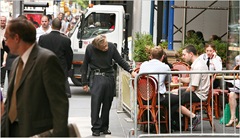
30bruni_CA1.600 Ten years later, in contemplation of my farewell, I searched inwardly to discern what I might be leaving behind, and the vague understanding I achieved was serendipitously captured by Frank Bruni in an amusing NY Times piece. He was attempting to explain why Manhattan diners would wish to eat al fresco, under unpleasantly demanding environmental circumstances. He came up with three theories and this was my favorite:

"Theory 2: New Yorkers have a highly evolved, unrivaled knack for glossing over the limitations, absurdities and dubious habitability of an unforgiving metropolis.

They walk into a friend’s 545-square-foot two-bedroom (one bath, no tub) and stammer: 'Just $4,965 a month for this?' They walk into the Spotted Pig at 5:55 pm on a Tuesday night and exult: 'Only a 90-minute wait?'

And they sit in a sidewalk cafe — sirens blaring, vagrants swearing and jackhammers jittering all around them — and sigh: 'It’s so relaxing to soak up the street life.'"

My own theory went something like: "Manhattan is great because you have the very best of everything, at your finger-tips, twenty-four hours a day." This was formulated around the time that I successfully located parts for the 40-year old toilet in our apartment, which, incidentally, were delivered same-day, by messenger, from Flushing, Queens. But that was all before the flourishing of Internet shopping.

After our move to the 'burbs I experienced a mild, yet fully-formed identity crisis. A shrub torn from the comfort of its nurturing asphalt garden, I dangled with my forlorn root ball exposed to scrutiny. Was it intact and vital? I did not know. What had I left behind? One thing about having a Manhattan address: you never tire of defining yourself by invoking it before strangers, and thereby it becomes part of you.

Let me return to my Year in Suburbia in Part Two of this post, but leave you with one clue: it all comes down to Summer vs. Winter.